SOAR Intern Podcast, Sarrah Farid on Bird Banding, Climate Research, and Advocacy
Host: Maya Xu. Guest: Sarrah Farid.
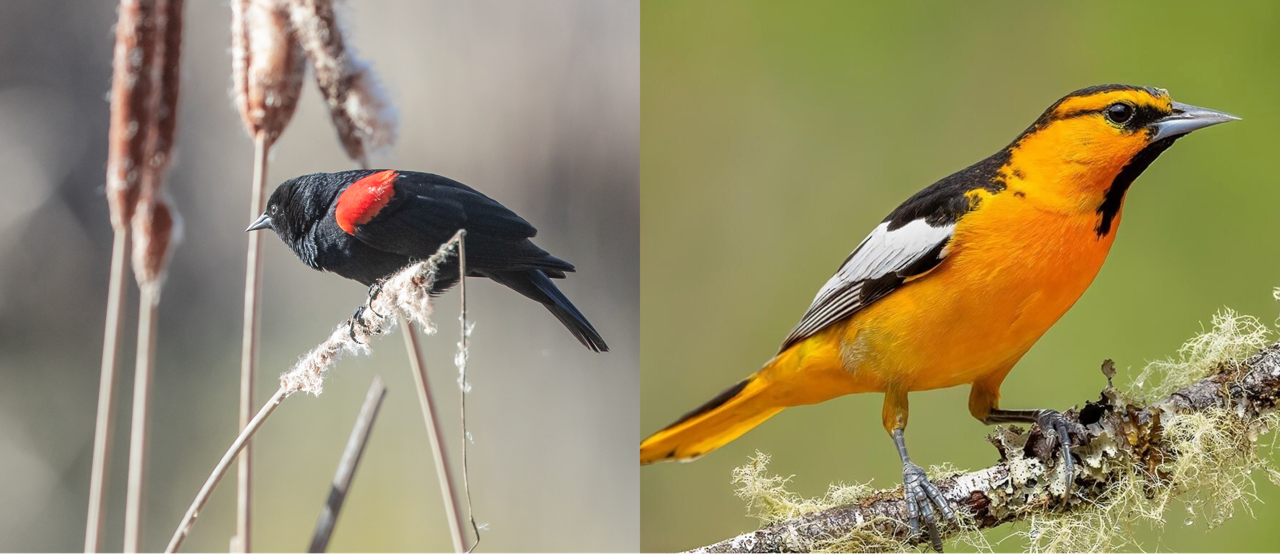
Figure 1. .Red-winged blackbird and Bullock’s oriole. Two of the birds that Sarrah and Maya enjoyed studying during their SOAR internships. Photo by Peter Hart (left) and Bullock's Oriole by Fernando Ortega / Macaulay Library (right).
November 22, 2026
Transcript: SOAR Intern Podcast, Sarrah Farid on Bird Banding, Climate Research, and Advocacy
Host: Maya Xu. Guest: Sarrah Farid.
Lightly edited for clarity and readability.
Maya Xu: Welcome to the SOAR Intern Podcast. I’m Maya Xu, a current SOAR intern. In this series, we’ll be talking with fellow interns about their experiences in the Student Opportunities in Avian Research program, also known as SOAR. SOAR brings together students, educators, and researchers from across the network of institutions in the Bay Area to support learning, research, and community building in ornithology and related fields. Through these conversations, we’ll hear firsthand about student experiences with birds and beyond, and how this has shaped our fellow interns’ journeys.
Today, I am super excited to be joined by Sarrah. Thank you so much for taking the time to share your story with us. So let’s go ahead and get started. Can I have you introduce yourself and tell us how you became interested in, or got linked up with, this internship opportunity?
Sarrah Farid: Yes, my name is Sarrah, thank you for having me. The way that I got this internship was kind of a fluke. It just came out of nowhere.
I had a professor, Michelle Geary, shout out to Michelle. She’s a professor at West Valley College, and she’s a wonderful professor. She taught plant biology and I was in her class. She has research teams within West Valley: one on redwood research and another on bird research. I had been contacting her, trying to get involved in the team for a while because I was interested, but she was really busy being a professor and doing redwood research. So it didn’t really happen until I was in her class. Basically, every other week after class, I would go up to her and ask, “So, is there something going on with the bird research team? Is anything happening?” She’d say, “Yeah, maybe. Hopefully. Write your name down, we’ll see.” She was trying to make it happen, but of course she was really busy. So I just kept going up to her and talking to her about it.
Then one time I went to see a movie with my family, and right before it started I looked at my phone and there was a message from her. She said the deadline had already passed, and the pushed-out deadline was that night, but there was this internship. She said, “I know this girl, Katie, who’s reaching out to West Valley College students saying, ‘Hey, there’s this internship for bird research. Is anyone interested?’ I just thought of you. If you want to do it, today is your last day.” I was like, “Oh my gosh, okay.” And then I said, “You know what? I’ll just do it.”
So I applied. It was, I don’t know, 9 or 10 p.m., and I wrote as good an essay as I could, a little application, and sent it out. It was already past the deadline, but Katie said it was fine, I could do it that day. Katie received it and said she’d let me know in a week. A week passed, and then she said, “Hey, you got into the internship. Would you like to join? You have to confirm by this time.” And I said, “Yeah, I’d love to do it.” So it was just really random how it happened.
Maya Xu: Score one for persistence! That’s awesome. Actually, hounding professors is sometimes the best way to get these kinds of opportunities. They remember you, they remember your interests, and they help move things along.
Sarrah Farid: For sure. Yeah.
Maya Xu: Awesome. So you initially became involved with SOAR because of this opportunity, which was working with Dr. Katie LaBarbera at the San Francisco Bay Bird Observatory, or SFBBO, because it’s a very long name. And you were one of the interns working at the bird banding station.
Sarrah Farid: Yes.
Maya Xu: Yeah, awesome. And that’s how I met you. Actually, I remember it was, I think, in July, right? Because your internship would have started in like June—
Sarrah Farid: May, actually. In May.
Maya Xu: Oh, wow. That’s really, really early. How long were you working with SFBBO?
Sarrah Farid: Three months, from May to August.
Maya Xu: Okay, gotcha. And yeah, I think I did meet you in July, maybe a little bit earlier. But I remember meeting you at the banding station. I think it was one of the Wednesday banding days, and I think you guys had been weed-whacking that day, or you were doing something else while clearing as well? Oh my god, that was so helpful. It’s a mess there right now. We really couldn’t [unclear]. That’s so awesome.
And so you started in May. What did the internship look like for you? How did it evolve over time, and what were you working on mostly?
Sarrah Farid: So mainly it was bird banding, learning how to band a bird, just observing everyone who already had experience there and trying to learn how to do that. And then also processing the birds and processing the data. But vegetation control was also part of the internship. Me and the other interns took care of all the invasive plants, taking them out and things like that. That was mainly what we worked on for May, June, up until about half of July.
And then that’s when we realized we needed to get going on a research project. Around halfway through July, we all started working a lot more seriously on our projects. We also each did a field guide on the Coyote Creek Field Station. Mine was on flowers, and I think the other interns did trees and insects and things like that. Those were the main things that happened during the internship.
Maya Xu: That’s so great. I feel like being out at the banding station and being so aware of the birds around you also makes you more aware of all the other bits of nature around you. I remember so many times when I’m out there with the birds and I see a snail going up a log, or some of the flowers growing by the nets, and I always want to know what they are, because you have that sense of awareness based on what you’re doing out there. So that’s really great. I did not know about that field guide, and I really want to see it. What was your process of making the field guide?
Sarrah Farid: It was mainly taking photos of flowers and then writing a description of what type of flower they are, and whether they’re invasive or native. A lot of them were native, which was really nice to see. It wasn’t really in relation to the birds or anything like that. It was mainly: are they native? What can they be used for? What do they help with? Things like that. But all of those things do go hand in hand with the birds, their health, and the entire ecosystem that works together. So it was interesting to do that field guide. I think Katie wanted some field guides to give out to people at the station, so we did that.
Maya Xu: Yeah. One of the things I wanted to ask you as well: of course, when I saw you, it was very much in the field, doing work with the birds. But was there an educational aspect to your internship? Were there folks you got to interact with who came to visit the station and got to read your field guides? Were there any interactions like that, that you got to have with the public about science?
Sarrah Farid: There wasn’t anyone, from what I know, who read my field guide or went through it, because we all turned them in at the very end of the internship. It was our final project. But with learning about science and teaching others about science, there were a few groups that came to Coyote Creek Field Station and also the Stanford station Jasper Ridge. There were a few groups that came there, and we got to watch Katie and the other research interns teach them about birds and share their experience with it. It was pretty cool.
Maya Xu: That’s awesome. Wait, we didn’t overlap at all, I think, at Jasper Ridge. That’s such a bummer. I usually go there because it’s a little closer for me. It’s a very, very different site from CCFS, with the vegetation and the capture rates. Do you have a favorite between the two?
Sarrah Farid: I think it’s Jasper Ridge, honestly.
Maya Xu: Really?
Sarrah Farid: I don’t know. I liked all the different birds that I saw there, and I just like the area more. I also thought it was very fun that we got to wear boots. I forgot my boots one time, but we got to wear boots for the deeper nets, and I thought that was really exciting. I also saw different animals there. I saw deer, and a bunch of different animals. We also hunted down a junco. We were using the speaker and trying to find it. I just have fun memories there.
Maya Xu: That’s awesome. Oh, so you were doing callback for the juncos. That would make sense, because Katie’s research has primarily focused on juncos since their PhD.
Sarrah Farid: Yeah, yeah. We were using the speaker and watching the junco, and it was about to go in the net, but it kept going around it. We were so close, and we were just watching it, and we finally got it at one point. I just have fun memories there.
Maya Xu: Oh yeah, totally. That’s so funny, actually. A lot of people who get the chance to work at both CCFS and Jasper Ridge, it always surprises me, and I feel a little disloyal saying this because Jasper Ridge. But a lot of people seem to prefer Jasper Ridge because it’s so different from CCFS, and the birds are different. Everyone loves that green vegetation, and I totally agree with you. The deep-water nets toward the end of spring, when it’s still really deep and mucky, are a really fun adventure to get to do, and it feels very deep field. CCFS sometimes doesn’t feel like that, but CCFS is great. It’s so good for teaching. So many birds come through, and so many different types.
Sarrah Farid: Yeah, for sure.
Maya Xu: Okay, well, I want to hear a little more about the stories you said you had from the field, but I want to circle back real quick, before I forget, to your research project. You mentioned that one of the goals of your internship was to do an individual research project. Can you tell us a little about what you were working on?
Sarrah Farid: Yes. For my research project, I was studying chestnut-backed chickadees, and then... oh, wait, no. Why am I forgetting? They’re an orange bird. Oh my gosh.
Maya Xu: Interesting, an orange bird. I’m trying to think of an orange bird and I am totally blanking.
Sarrah Farid: Bullock’s oriole.
Maya Xu: There we go, oh my gosh! Whoa, you’re studying Bullock’s orioles?
Sarrah Farid: Bullock’s orioles, there you go.
Maya Xu: Wow, wait, that is amazing. I’ve been there now for, let’s see, I started after my junior year, and technically I just got my master’s. So in the almost three years I’ve been at the station, I’ve only seen, sorry, two Bullock’s orioles.
Sarrah Farid: That’s pretty awesome. Yeah, that’s what I wanted. I personally haven’t seen Bullock’s orioles when I was banding, but I wanted to do that as a project because they have been seen before at CCFS. I wanted to study birds that were very different from each other. And I love chickadees, so I wanted to do them. So I did those two species, and it was kind of a comparison.
Me and the rest of the interns were all focused on the main goal: how does climate change affect these birds? How is global warming affecting these birds, and in what ways? For mine, it was Bullock’s orioles and chestnut-backed chickadees, studying how rain, temperature, and habitat loss affect them. I studied both species and looked at how each one was able to adapt or not adapt. I found that chestnut-backed chickadees could adapt much more easily to these varying rates of temperature and precipitation, but Bullock’s orioles had a much harder time. So it was very interesting.
Maya Xu: So interesting. Did you have a theory in your research as to why this would be? Those two birds have really, really different life histories, and I’m curious what it might have been that made chestnut-backed chickadees more adaptable.
Sarrah Farid: Yes. My theory is a little out there, but I think chestnut-backed chickadees are more resilient to these changes because of their sociality. They’re such social birds, and they usually hang out in flocks with other birds. The other thing that’s really interesting about them is that they don’t just spend time around other chickadees. They spend time around other types of birds, and those other birds help them do different things.
There have been studies where, if they’re in a spot of danger, the other birds will do something to protect the chickadees, or they’ll protect each other in different ways. Certain birds are better at getting certain insects or doing certain things, and so they do that. It’s so cute, because everyone is using their own strengths to help the flock. And because of that diversity within the ecosystem, I think they’re able to be more resilient to those changes.
Bullock’s orioles really don’t spend much time in flocks. They’re mostly individual. It’s only during migration that they’re with other birds, and they don’t spend time with other types of birds. So my theory was that it’s because of the chickadees’ diversity and their ability to adapt to changes, because of the way they spend time with other birds and are able to have a kind of community.
Maya Xu: Yeah, no, that makes a ton of sense. I just got back a few days ago from the American Ornithological Society’s conference, which SOAR very kindly sponsored me to go to. There was a whole section where people were giving oral presentations and posters on community ecology, and of course mixed-species flocks led by chickadees were a big part of that. There was also a really interesting presentation about how that degree of sociality can indicate different levels of intelligence that maybe we haven’t taken into account for chickadees and other birds in that family “parrots”. It’s really interesting to think about how that might make them more adaptable to the challenges they’re facing, as opposed to, say, Bullock’s orioles, which, outside of the migration season, as you were saying, might have to rely on themselves a lot more and don’t have that [unclear]. So that’s really, really cool.
It sounds like you had to do a lot of literature review for this project, then. Can you talk us through your process of completing the research project, and maybe how Katie walked you through it? And was this your first research project too? I’m curious about that.
Sarrah Farid: Yeah, it was my first research project. And let me tell you, it’s so funny, because when you do your first research project and then look back at it later, you think, “Oh gosh, what was I doing?” I was just looking back at it with my fellow intern from last summer, Sylvia, and with Katie, and I told them, “I did not know what I was doing.” I was just winging it, no pun intended, just putting it together, throwing in whatever I had. But that’s how it is your first time.
Katie definitely helped me a lot. She helped all of us throughout the internship, and I think I learned the most from her, because she was so patient and so encouraging toward any question we had. Even if it was kind of a dumb question, or I felt like I should already know the answer, she was always encouraging. She never made us feel bad about it. She was also about eight or nine months pregnant at that time, but she was on top of it, and every time we had to do a meeting for a research project, she’d say, “Yeah, I can meet this day.”
Sylvia even brought up something that was pretty funny. She said she was trying to contact Katie about her research project, and Katie said, “Oh, I’m sorry, I can’t do it that day, I’m giving birth, but I can do it the next week.” And we were like, “What?” Of course you don’t have to do that! If you’re that close, I’d say, “Oh my gosh!” But she was very much on top of everything. She was so dedicated to helping, and I think she has a lot of passion for it, and that’s why she was so dedicated all the time. But yeah, she helped me a lot through the projects. And at one point, she actually made my graph for me, because I was only just working on it, so she did it too. But yeah, very, very good.
Maya Xu: Yeah, that’s great. Katie is a great mentor, and I feel the same about her. I didn’t do a research project with Katie. I was in the classroom at the time, mainly participating, but of course she was teaching everyone how to do all the banding techniques. I learned a lot of skills with birds in the hand under their guidance, and of course also looking at Pyle to see all of those traits and try to translate them into the field.
But yeah, I also totally agree. I mean, it’s crazy that Katie felt the need to respond and say, “Sorry, I can’t meet because I’m giving birth that day.” But honestly, it’s also been so inspiring to see how they’ve been juggling the responsibilities of motherhood and running a field station and continuing to do science and mentoring other people. For me personally, that’s been really inspiring, and it sounds like it’s been inspiring for you too, as you’re starting out in the field.
Sarrah Farid: Yeah, for sure.
Maya Xu: That’s super awesome. It sounds like you learned a lot in your internship about getting your research project together, like the ideation process and figuring out what you’re interested in. That’s ultimately a really good foundation for wanting to get into research, because if you’re not interested, then what are you doing? You’re never going to follow through.
And it sounds like you learned literature review and hopefully a bit about graphing, even if Katie had to stage a rescue toward the end of the project. [Laughs] Was there another skill you learned, either through your project or throughout the internship, that surprised you? I would love to talk more with you about your experiences with birds in the hand, but anything that surprised you about being in the internship would be great to hear.
Sarrah Farid: Something that surprised me, honestly, was that I didn’t realize this was a whole world. Before, I knew there was environmental science and there were people who majored in that, or people who majored in ecology. But I didn’t know there could be a whole field station with a bunch of interns and researchers who came and studied birds specifically, with full careers in it, doing PhDs on it and everything. That was really eye-opening for me, and really cool to experience, because it’s exciting when you find out there are fields like that, whole worlds like that.
Another thing that surprised me was connecting with Katie and with my fellow interns, who I became friends with and am still friends with now. Something we talked about a lot throughout the internship was the intersection between social justice and science, which I didn’t really expect. I have a big passion for social justice and advocacy, and I also really love science, so I didn’t think I would find people who would talk about the same things or speak about the same injustices within environmental law. But I really did find those similarities with my fellow interns and with Katie. We had a lot of discussions like that, and about the passion we had to protect the ecosystems around us, the environment around us, the birds and the amazing species around us that we’re all passionate about. Of course, we have a hard time with that, because often there aren’t other people who want that same protection. It ignited that passion more, I guess, because I realized how important it was.
I felt like I learned a lot from Katie because of everything she has had to deal with, making sure CCFS is supported and stays protected, making sure SFBBO can continue and flourish, and the same with SOAR. I learned a lot about that.
Maya Xu: I’m so glad that SOAR was able to give you that space and that experience, because I think, especially right now, science as a whole, and conservation science in particular, and of course, as you mentioned, environmental justice, have been coming under fire. It’s really important to have those communities to be a part of, to talk with, and to fight together. I’m really glad we’re able to provide that space for you, and that it’s continuing into the future. And wow, that’s awesome that you’re still in touch with the interns you were with that summer. I remember you had such a great rapport, so it’s good to have that extend into the future.
I’m so curious, for you specifically, of course, but for all of you as well: when I met you, you were at West Valley College, but now you are making a transfer, and you’re going to finish your last year of college at San Jose State, right?
Sarrah Farid: Yes. It’s actually two years, but yeah.
Maya Xu: Last two years, gotcha. For you and for the other interns, are you all planning to continue pursuing some kind of environmental field? Was SOAR something that encouraged you to do so? I would love to hear more about your future plans before we circle back to some of those fun stories in the field, because I do want to end on that.
Sarrah Farid: For sure. Yes, I think all of us want to pursue it in some way. I know that Kira is an environmental science major. She wants to pursue that field specifically, and I think she just got an internship working with clean energy. She’s killing it out there. And Maya also wants to, she’s a biology major, but she wants to pursue it in some way. I think she mostly wants to work in conservation. And Sylvia’s pre-med, so she wants to go into medicine.
But Sylvia, Katie, and I are actually continuing the research that we started. Sylvia did the research project that we originally started from, and we’re kind of merging them together. We’re currently extending that research. We’re working on Bullock’s orioles and continuing that research with Katie, trying to figure out how climate change affects the Bullock’s orioles, and also, I’m not sure where I got cut off, we’re continuing our research on common yellowthroats for Sylvia’s, and mine is... right, right. So Sylvia’s is common yellowthroats. We’re trying to see how climate change is affecting both of those birds, because they’re both pretty interesting species to study for how climate change and habitat loss are affecting them.
For my career plan, I hope to pursue a career in law for healthcare and bioethics. But mainly I want to pursue the field of public interest law, because it covers different areas of law, including healthcare law and environmental law, which I’m really passionate about. I’m super passionate about healthcare law too. I want to fight the injustices within the healthcare system and also work on the things we need to work on within environmental law. That’s how I’m merging those two passions. And I definitely feel those passions got more ignited after doing this internship and learning more about why we need to protect these [unclear].
Maya Xu: That’s fantastic. We need more folks who are doing interdisciplinary work, whether it’s within science, or in law, or in advocacy. So it’s really awesome to hear that’s what you’re planning to pursue.
Okay, one more thing I wanted to ask before we circle back to those field stories. Do you have any advice you would give to a student who’s considering an internship or opportunity provided by SOAR in the future?
Sarrah Farid: I would say just learn as much as you can and take advantage of the opportunity to the greatest extent. It’s a wonderful opportunity. Learn as much as you can, but also have as much fun as you can, because there’s a lot of fun to be had with your fellow interns and with the researchers. I had so much fun chatting with all the other people I was working with there, all the other volunteers and the interns. I learned a lot from them. They had a lot of interesting stories and advice about their lives and their careers, and what they would advise if we wanted to go into environmental studies or environmental law. They had a lot to say, and I learned a lot from them, and I also just had a lot of fun. So my advice is: learn as much as you can and try your best, but also remember to have fun and make connections with people.
Maya Xu: That’s fantastic. I think that’s really good advice, and I totally feel that as well. I have learned a lot about environmental consulting specifically from chatting with other folks at SFBBO. It has been super helpful in case that’s a field I want to consider in the future. There are so many diverse experiences within birds and science and advocacy that exist within that space, and it’s always so helpful and so fun to hear from them.
Okay, I want to make sure I let you go, because this has gone longer than [unclear], but I do want to bring it back to the birds to end this. We’ve talked a lot about Bullock’s orioles, and since you’re continuing with that project, I’m going to assume that’s one of your favorite birds, at least. But I’m going to ask you two questions.
First, this is a bit of a cruel question, because whenever someone asks me, I always start by saying, “Oh gosh, it changes every minute, every hour. It depends on what I’m thinking about or who I’m working with.” But I’m going to ask you right now: who is your favorite bird, and why? And second, can you share one memory from the banding station? Maybe it could be the first bird you ever got to extract from a net, or a really exciting extraction. Since you have a thing for chickadees, I’m sure you have some stories about that, but maybe one story from the banding station that has stuck in your memory for a while.
Sarrah Farid: Okay. Yes, I love Bullock’s orioles. I also love chickadees. I always have, but I feel like I’ve grown more love for those two birds after studying them a little more. But I think currently my favorite bird is the red-winged blackbird, because they’re just so pretty and I love the sound they make. It’s mainly because it reminds me of Yosemite, and I love Yosemite. Yosemite is my favorite National Park ever, and I love going there.
Last time I went, I was there at sunrise, in the meadow, and there was a little red-winged blackbird at the top of a sign, making its noise. I was just like, “Aww, that’s so cute!” But it was also very peaceful, with the red-winged blackbird right there. I felt at peace. So I have that memory attached to red-winged blackbirds, and they’re also just so pretty. Every time I see them, it reminds me of that and I get happy. So I think that’s my favorite bird currently.
Maya Xu: Good choice. Pretty birds are worth a lot. Even though all of them are pretty, some definitely have a little something extra special. I totally agree about the blackbirds. Okay, cool. And one experience from the banding station that you can share with us?
Sarrah Farid: I think honestly it was just the first day I interned there. It was my first day banding. I remember coming super early in the morning, and it was pitch black when I first got there. I was like, “What am I doing here? This is crazy.” It was a surreal experience.
That was the first time I got to see a bird being banded. It wasn’t taking it from the net, but I got to see it happening and see it being processed. I’m pretty sure the first one was a bushtit, and it was screaming. It was so unhappy. It was chirping all around, like, “Get me out of here.” I just thought it was really cute. I remember telling Katie, “Wow, he’s really hyper,” and she said, “Yeah, that’s bushtits. They’re very social, and they’re going to tell you they’re not happy about what you’re doing.” I thought that was very cute, and very sweet. That was the first time I experienced that, so I think that was my favorite memory.
Maya Xu: That’s awesome. One thing I definitely had to learn over the course of my time banding is that the noisier and bitier the bird is, the better it is for that bird, because it means they’re feisty and full of rage and have enough energy to fight back. It’s always interesting to learn, when you have birds in the hand, what the signs of stress or the signs of feistiness are, basically reading their bodies and being able to tell their stories and learn about them in the small period of time that you have them. It’s something you can’t get unless you’re at a banding station.
Sarrah Farid: For sure.
Maya Xu: Really great that you got to have that experience. And oh my god, bushtits are the cutest little buttons of birds ever.
Sarrah Farid: Yeah, it is so cute.
Maya Xu: That’s awesome. All right, closing out, one very last question. What takeaway about birds and avian conservation would you like to leave listeners with?
Sarrah Farid: I think just that it’s very important that we fight to protect them. Of course we already know this, but through pursuing more research and learning more about them, we learn more and more about why it’s so important to protect them, for our lives and for the Earth’s life and for our whole world.
While it is really important that we keep researching them and learning more about them, and that’s very fun, I also want to leave listeners with a note: make sure to fight for it. Make sure to use your voice and advocate for better environmental laws and better conservation laws, because if we don’t, no one will.
Maya Xu: Yeah, no, absolutely. Using our voices, because they can’t, or at least they don’t have voices that everyone can understand. That’s so important. Totally agree.
All right, well, thank you so much, Sarrah. It was great to chat with you again, since it’s been a little while. Thank you for being a part of this and for being a part of SOAR. Since you’re transferring to an affiliated institution, I hope you’ll still be able to be involved in the future and come back to the station, because things are going to get really fun with fall migration, and you should definitely come back.
Sarrah Farid: For sure, yeah.
Sarrah Farid was a SOAR intern alum transferring from West Valley College to San Jose State University, where she plans to continue her bird research and prepare for a career in public interest law.
Maya Xu earned her B.S.H. (2025) and M.S. (2026) in Biology at Stanford University, was a SOAR intern, and is a docent at Jasper Ridge Biological Preserve ('Ootchamin 'Ooyakma).