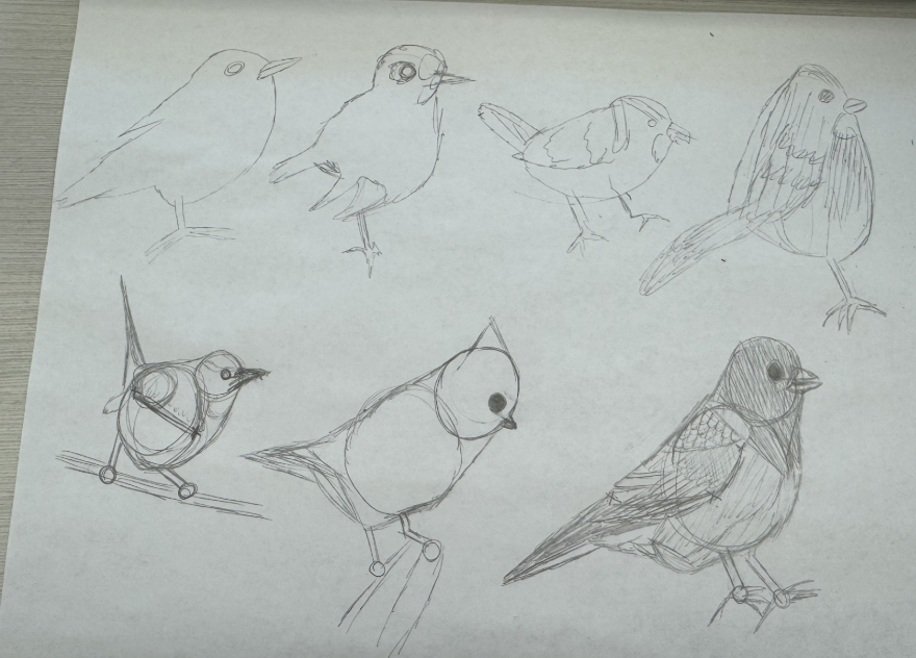
Drawing on Inspiration
SOAR students experience the joys of sketching birds with ornithologist and artist Jack Muir Laws
SOAR students experience the joys of sketching birds with ornithologist and artist
By Maya Xu
On the morning of April 21st, 2026, our ornithology class (Stanford’s BIO 121) was taken by storm. For the past two weeks, students mainly learned about birds through photo-filled, fact-packed lectures, along with our second year of our new module “70 Birds in 10 Weeks,” where students learned to identify seven new California birds a week. But even though we’d already packed our schedule with plenty of interactive learning and two field trips, Marty, Rodolfo, and I wanted more. SOAR support allowed us to arrange for a very special visit by renowned artist, educator and naturalist Jack Muir Laws to Stanford.
Our teaching team had historically struggled to make our anatomy and physiology module as interactive as we hoped it could be. Last year, we mainly spent our class period looking at diagrams of the avian body, with a mid-class burst of laughter when Marty brought out exercise bands to make students flap with their pretend supracoracoideus (thanks, Ben Moran, for the great original idea!). It was Marty’s suggestion to have Jack come in and get the students active with their pens and paper. After all, what better way to get to know a bird’s body then by drawing them yourself?
The second Jack started to speak, our students were hooked. He brought his gorgeous sketchbooks for us to flip through as he recounted his own journey of learning to draw living birds. Our students let out a collective ‘aww’ when Jack brought up a picture of a criminally fluffy Bewick’s Wren on the screen. “Take a look at this little bird,” Jack instructed. “Get a good look aaaand now it’s gone! Draw what you remember!” Everyone scrambled to put pencil to paper, laughing as we all tried to recall the image we’d just seen moments ago. “And done!” Jack crowed. “Next bird! Go!”
It was a mad dash through every thinkable way to draw a bird – seeing the bird for just a couple of seconds, drawing without looking down, even drawing without lifting your pencil! We were all giggling by the end of it, ready for Jack to tell us exactly what to look for, based on his own patented methodology.
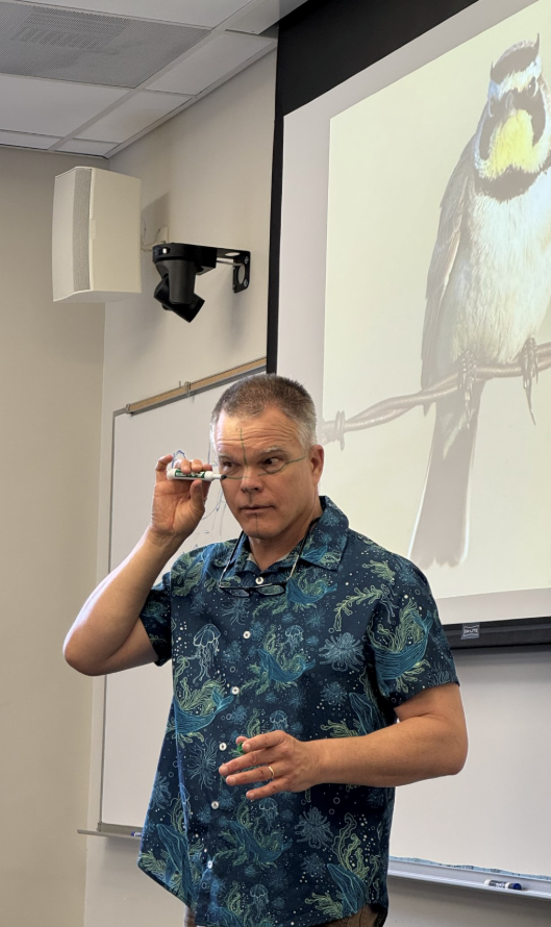
Jack drawing on the planes of his face while teaching us to draw a front-facing Horned Lark. Photo by the author.
“The lines of a bird are most important to draw first,” he urged. “Because if you don’t do that – oops, your bird’s already moved!” As he started to draw the wren, he pointed out the general roundness of the bird, the almost 90-degree tilt to its long tail, the slight curvature of its bill. All the students were silent as they copied him, the only sounds in the classroom the scratching of pencils and Jack’s voice.
In just two hours, Jack led us through a whirlwind of content. He drew lines onto his own face with a marker to show us how to show the 3D planes of a front-facing bird’s face, sending us into gales of laughter.
I was amazed after looking at the progression of my own drawings. I’d never considered myself an artist of any skill, and now I could see the character of my birds jumping off the page with just a few pencil lines. The students around me were admiring their own sketches by the end of the session, similarly in awe of how far they’d come in such a short time.
After a wonderful lunch together (and an extra one-hour workshop that Jack gave one of our students who asked about drawing bird wings!), we drove over to the O’Donohue Family Stanford Educational Farm, where Jack had agreed to give a second workshop for the wider SOAR community. We had volunteers from the San Francisco Bay Bird Observatory, and students from Stanford, West Valley College and Santa Clara University. Unlike the morning session, Jack sat us all down around the round table and asked everyone, “What are you most hoping to get out of this workshop?”
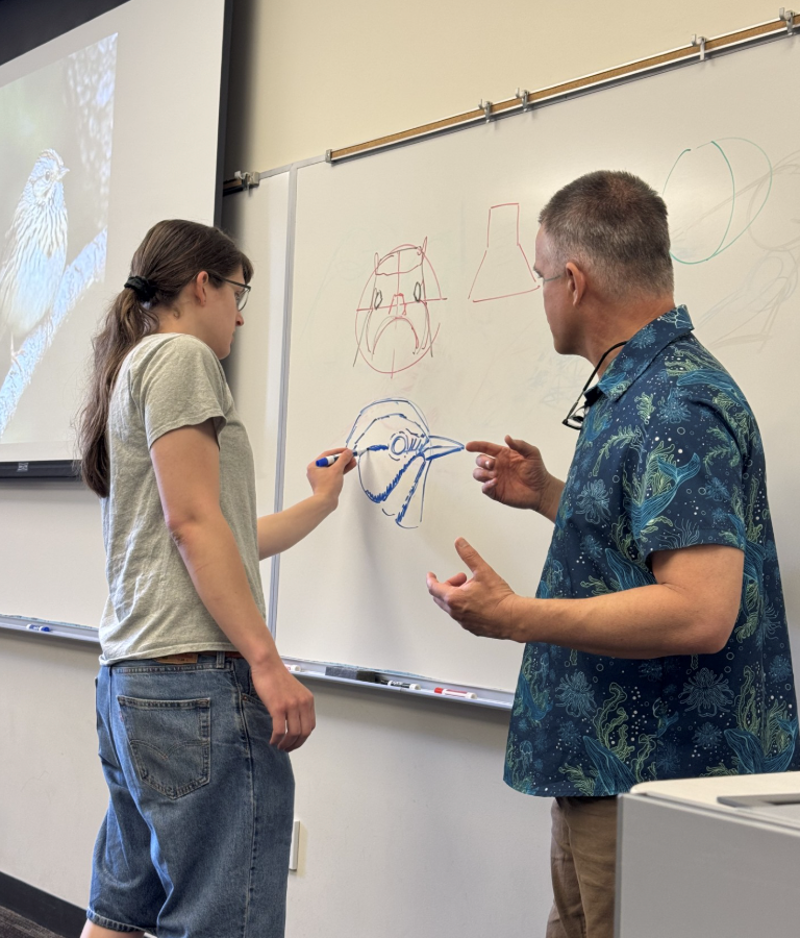
One of our students drawing the facial features of a Song Sparrow under Jack’s expert guidance. Photo by the author.
In two hours, he flashed through a carousel of topics – from drawing a full set of flight feathers on a bird wing, to using watercolors to accurately represent a bird’s plumage, to a final 5-minute boot camp on how to capture the sparkling iridescence of a hummingbird’s gorget. And of course, there were plenty more adorable photos of birds to look through together, from the stunning plumage of a male Rose-breasted Grosbeak, to the rotund body of a Golden-crowned Sparrow.
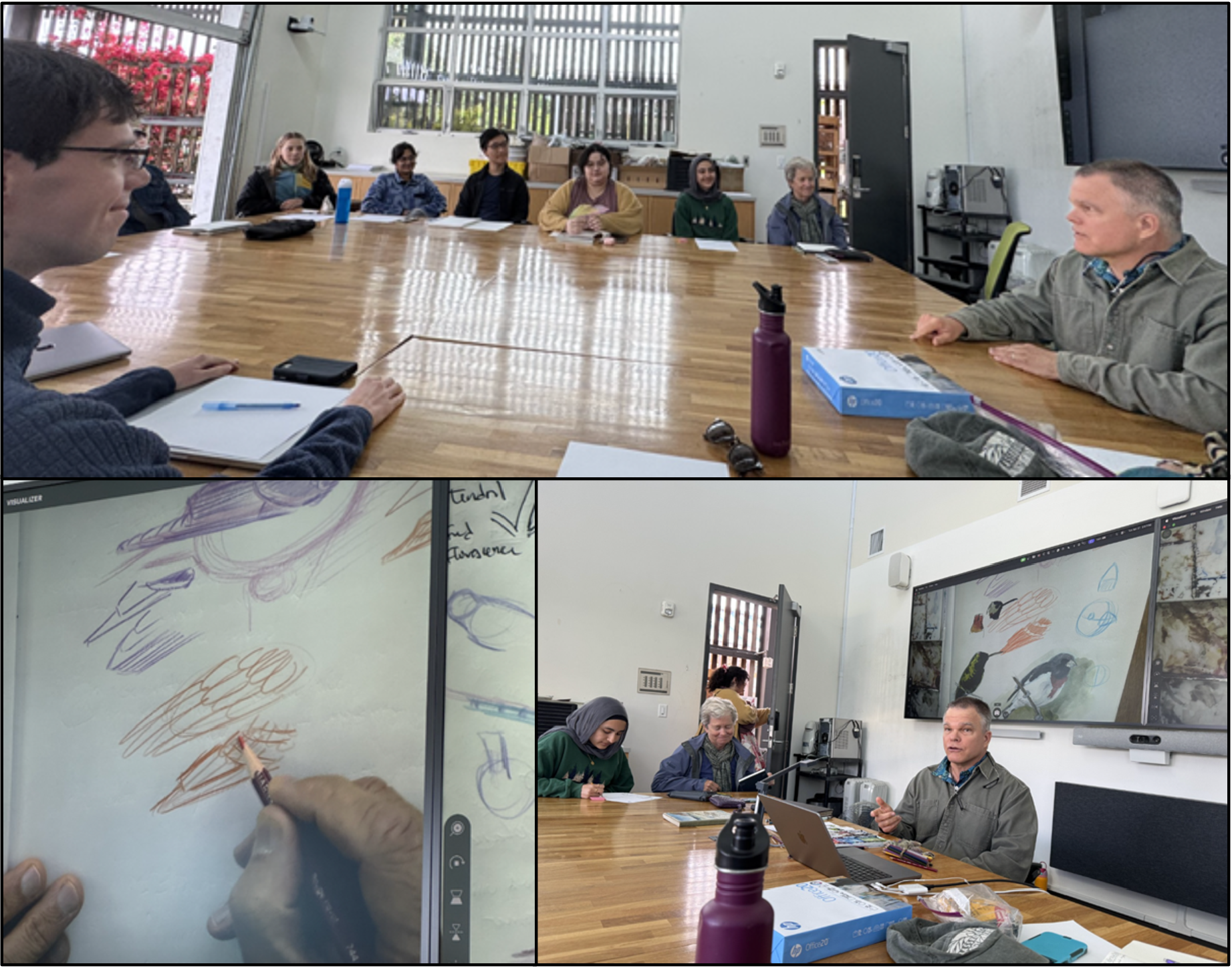
Photo collage of moments from the start through end of our workshop for SOAR. TOP: SOAR participants gather at the O’Donohue Family Stanford Educational Farm. BOTTOM RIGHT: Jack demos how to accurately sketch a bird’s wing. BOTTOM LEFT: Projection of Jack sketching a bird’s wing for the group. All photos by the author.
All of the students who worked with Jack that day left the room smiling, inspired to continue noticing and documenting the birds around them in their daily lives. The teaching team looked at each other with a smile too, knowing that through this SOAR event, we’d been able to inspire another group of students to consider the avian world in a different light. In future class sessions we could see the difference this one session had made, from the students’ careful consideration of rump patterns in their applied assignment on whimbrel taxonomy, to their extra detailed descriptions of the birds we saw together when they reflected on our visit to Jasper Ridge’s bird banding station. By engaging their senses in the classroom and literally flexing new muscles to engage in deliberate practice, this new educational module introduced our students to an additional way of learning not only about birds, but observing the living things around them with the eye of an artist.
With Jack’s expertise and excitement, we’d been able to encourage our participants to leave as amateur naturalists themselves, bringing them into closer contact with the beautiful nature around them.
Instructor’s evaluation of the effort as a mechanism to improve science education
Through bringing John Muir Laws to campus, students had the opportunity to interact with a renowned naturalist with a differing career path from their usual instructors. They also engaged with methods of observing and documenting nature that were previously not available in the class, creating a greater sense of community in the classroom through enjoying the process of making art together. By placing this module directly after a lecture covering anatomy and physiology, students were able to cement their previous knowledge through hands-on activities that promoted detailed observations of their avian subjects. The instruction team was also able to use this module as a scaffold for deliberate practice, through in-class sketching and future activities where they were asked to use their new skills of observation in an applied ornithological context. Overall, this experience provided students with another avenue of training in avian science, as well as a previously unincorporated method of ornithological education beyond merely being presented information in a traditional lecture format.
Maya Xu is a bird lover who recently earned her B.S.H. in Biology (‘25) and Master’s in Biology (‘26) at Stanford. During her time at Stanford, she was part of Professor Rodolfo Dirzo's lab and a SOAR intern. She is a docent at Jasper Ridge Biological Preserve ('Ootchamin 'Ooyakma).